Smart Hotel Technology: What It Costs, What It Saves, and What to Buy First
“Smart hotel” has become a catch-all. It gets used for app check-in, for voice assistants in the room, for a dashboard the engineering team looks at once a month. Most of it is real technology. Very little of it changes a hotel’s operating cost.
This guide is about the part that does. What smart hotel technology actually covers, which pieces pay for themselves, and the order to buy them in if you are starting from a property that has none.
What counts as smart hotel technology
It helps to split the category by what the technology is actually doing, rather than by what it is called on the brochure.
- Guest-facing systems. Mobile keys, in-room tablets, app-based service requests. These affect guest experience and staff workload. They do not move the energy bill.
- Building and plant systems. A BMS controlling chillers, AHUs and pumps. Powerful, expensive, and usually installed at build or major refurbishment.
- Guest-room control. Occupancy-based automation of the room’s own HVAC. This is the layer most hotels are missing, and it sits on the largest single controllable cost in the building.
- Measurement and reporting. Metering, benchmarking and ESG reporting. Not a saving on its own, but it is how you find out whether anything else worked.
Our rundown of seven smart hotel technologies goes wider across all four. What follows concentrates on the third and fourth, because that is where the money is.
Start with the biggest load in the building
In Southeast Asia, air conditioning is the single largest energy load in most hotels, commonly 40% to more than 60% of the electricity bill. Nothing else on the meter comes close. And a large share of that cooling goes into rooms with nobody in them: a guest leaves for the day, the fan coil keeps running, and the hotel pays for it.
That is the gap occupancy-based automation closes. Sensors read whether a room is genuinely occupied, ease the cooling back when it is not, and bring it back before the guest returns. A properly configured system running this way cuts guest-room HVAC energy by 20-30%.
At Anantara Vacation Club Mai Khao in Phuket, the measured reduction has held at 28% across 21 months. That is metered kWh over nearly two years, not a projection from a spreadsheet.
Smart hotel equipment: what actually goes into a room
The physical kit is smaller than most people expect. A typical guest-room retrofit is a wireless thermostat, an occupancy sensor, and a controller on the fan coil unit. No cabling through the corridors, no ceiling work, no room out of service overnight. SmartREM installs at about ten minutes a room, which is the difference between a project the hotel can do around occupancy and one that needs a floor closed.
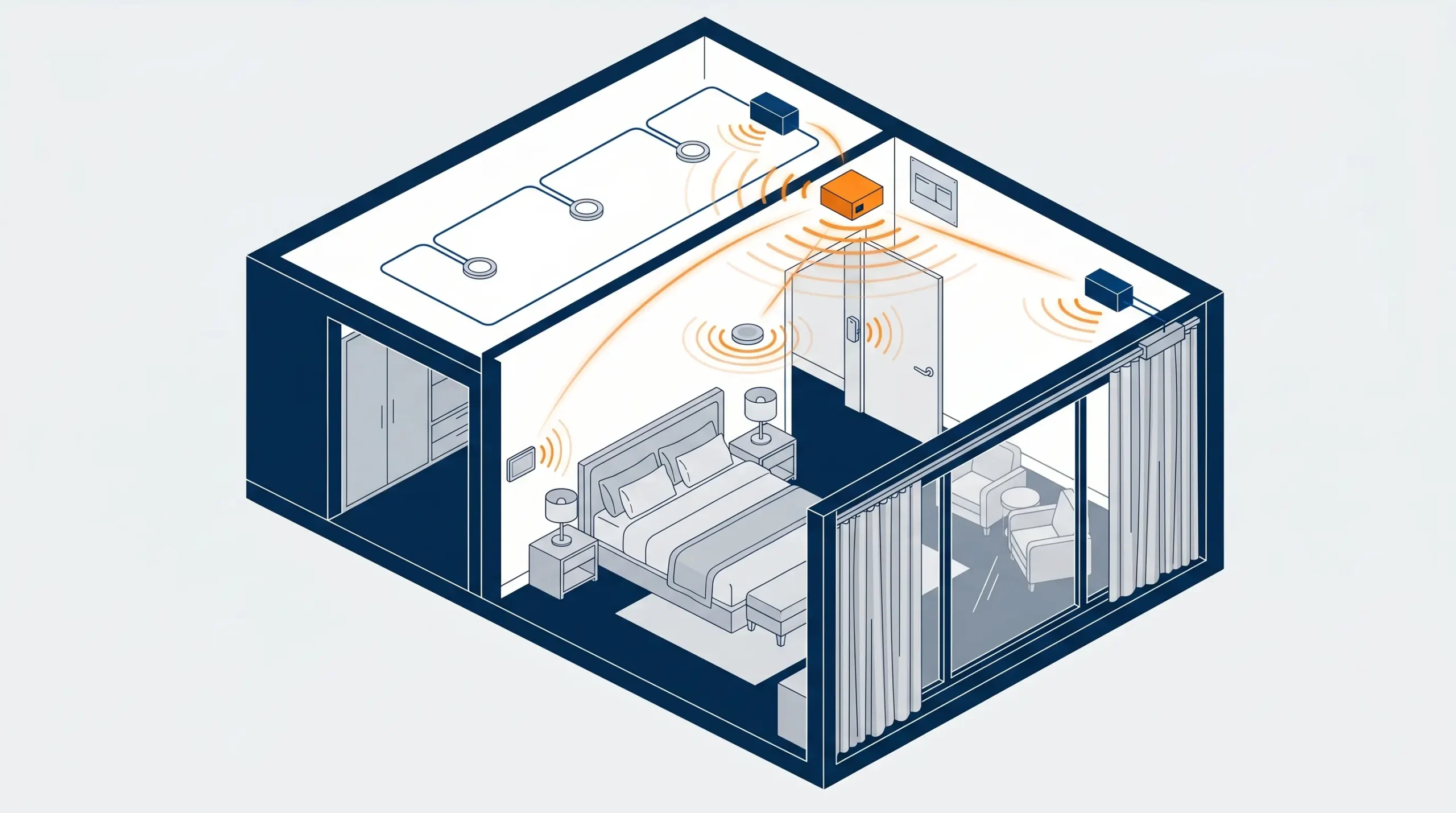
The rest of the system is software: the logic that decides when to pull back, and the reporting that proves what it saved.
Retrofit or rip out
Hotels with a working BMS often assume they are covered. They usually are not. A BMS controls central plant well and guest rooms poorly, because it has no reliable idea of which rooms are occupied. Keycard systems have the same blind spot in reverse: they cut power when the card is pulled, which guests defeat with a spare card in seconds.
Guest-room automation sits alongside both rather than replacing either. Our guide to hotel energy management systems sets out where each approach fits and what it can and cannot do.
What to buy first
If you are starting from nothing, the sequence that wastes least money is:
- Measure. Find out where the energy actually goes before you buy anything. Benchmarking against comparable properties is free and it usually reorders your priority list.
- Automate the guest rooms. The largest controllable load, the fastest install, the clearest measured return. SmartREM is the system we build for this.
- Monitor continuously. Savings decay when nobody is watching. Real-time monitoring catches drift while it is still small.
- Then look at plant. Chiller optimisation and plant upgrades are real, but they are slower, dearer, and easier to justify once the room-level data exists.
How to tell a real system from a dashboard
Four questions separate the two:
- Does it act, or does it only report? A dashboard that tells you a room is cold at 3am has not saved anything.
- Is the saving measured in metered kWh, or modelled? Ask for the meter data and the baseline method.
- How long is a room out of service during install?
- What happens to the numbers in month eighteen? Ask for a property that has been running two years, not two months.
Frequently asked questions
What is a smart hotel?
A hotel where building systems respond to what is actually happening in the property rather than to a fixed schedule. In practice the term covers everything from mobile check-in to occupancy-based HVAC control, so it is worth asking which part someone means.
How much does smart hotel technology save?
For guest-room HVAC automation, 20-30% of guest-room HVAC energy is the range we see in metered results. Savings from guest-facing technology are real but show up in labour and satisfaction, not on the electricity bill.
Does a hotel need to close rooms to install it?
Not for a wireless retrofit. SmartREM installs in roughly ten minutes a room and can be done around occupancy, floor by floor.
Will guests notice?
They should not. Automation pulls cooling back only when a room is genuinely empty and restores it before the guest is back in it. Comfort is held where it matters.
Where to start
If you want a number for your own property rather than a range, the fastest route is a look at your current consumption and room count. That takes a conversation, not a survey.
New to hotel energy savings and not sure where to start? Hotel Energy Savings: Where to Start When You Don’t Know Where to Start maps the whole landscape across regions and the four-step method (measure, automate, sustain, prove) — useful context alongside this piece.